BONUS!!! Download part of TorrentExam C-ABAPD-2309 dumps for free: https://drive.google.com/open?id=1f8xLSxcQvRIGD69uXQ_r6zr1Dreu2rwY
If you want to pass the C-ABAPD-2309 exam, our C-ABAPD-2309 practice questions are elemental exam material you cannot miss. It is proved by our loyal customers that our passing rate of C-ABAPD-2309 practice materials has reached up to 98 to 100 percent up to now. Besides, free updates of C-ABAPD-2309 Exam Torrent will be sent to your mailbox freely for one year, hope you can have a great experience during usage of our C-ABAPD-2309 practice materials.
The TorrentExam wants to win the trust of SAP Certified Associate - Back-End Developer - ABAP Cloud (C-ABAPD-2309) exam candidates at any cost. To fulfill this objective the TorrentExam is offering top-rated and real C-ABAPD-2309 exam practice test in three different formats. These SAP C-ABAPD-2309 exam question formats are PDF dumps, web-based practice test software, and web-based practice test software. All these three TorrentExam exam question formats contain the real, updated, and error-free SAP C-ABAPD-2309 Exam Practice test.
>> New C-ABAPD-2309 Dumps Ebook <<
The competition in IT industry is increasingly intense, so how to prove that you are indispensable talent? To pass the C-ABAPD-2309 certification exam is persuasive. What we can do for you is to let you faster and more easily pass the C-ABAPD-2309 Exam. Our TorrentExam have owned more resources and experiences after development for years. Constant improvement of the software also can let you enjoy more efficient review process of C-ABAPD-2309 exam.
| Topic | Details |
|---|---|
| Topic 1 |
|
| Topic 2 |
|
| Topic 3 |
|
| Topic 4 |
|
NEW QUESTION # 70
Which of the following are features of Core Data Services? Note: There are 3 correct answers to this question.
Answer: B,D,E
Explanation:
Core Data Services (CDS) is a framework for defining and consuming semantically rich data models in SAP HANA. CDS supports various features that enhance the capabilities of SQL and enable developers to create data models that are optimized for performance, readability, and extensibility12. Some of the features of CDS are:
* Associations: Associations are a way of defining relationships between CDS entities, such as tables or views. Associations enable navigation and path expressions in CDS queries, which allow accessing data from related entities without explicit joins. Associations also support cardinality, referential constraints, and cascading options34.
* Annotations: Annotations are a way of adding metadata to CDS entities or their elements, such as fields or parameters. Annotations provide additional information or instructions for the CDS compiler, the database, or the consumers of the CDS views. Annotations can be used for various purposes, such as defining access control, UI rendering, OData exposure, or search capabilities5 .
* Structured Query Language (SQL): SQL is the standard language for querying and manipulating data in relational databases. CDS is based on SQL and extends it with additional features and syntax. CDS supports SQL features such as joins, aggregations, filters, expressions, functions, and subqueries. CDS also supports SQL Script, which is a scripting language for stored procedures and functions in SAP HANA .
You cannot do any of the following:
* Inheritance: Inheritance is not a feature of CDS. Inheritance is a concept in object-oriented programming that allows a class to inherit the properties and methods of another class. CDS does not support object-oriented programming or classes.
* Delegation: Delegation is not a feature of CDS. Delegation is a concept in object-oriented programming that allows an object to delegate some of its responsibilities to another object. CDS does not support object-oriented programming or objects.
References: 1: Core Data Services (CDS) | CAPire 2: Core Data Services [CDS] in SAP S/4 HANA | SAP Blogs 3: Associations in Core Data Services (CDS) | SAP Help Portal 4: [CDS DDL - Association - ABAP Keyword Documentation - SAP Online Help] 5: [Annotations in Core Data Services (CDS) | SAP Help Portal]: [CDS DDL - Annotation - ABAP Keyword Documentation - SAP Online Help] : [Structured Query Language (SQL) | SAP Help Portal] : [CDS DDL - SQL Features - ABAP Keyword Documentation - SAP Online Help] : [Object-Oriented Programming in ABAP | SAP Help Portal]
NEW QUESTION # 71
For what kind of applications would you consider using on-stack developer extensions? Note: There are 2 correct answers to this question.
Answer: A,B
Explanation:
On-stack developer extensibility is a type of extensibility that allows you to create development projects directly on the SAP S/4HANA Cloud technology stack. It gives you the opportunity to develop cloud-ready and upgrade-stable custom ABAP applications and services inside the SAP S/4HANA Cloud, public edition system. You can use the ABAP Development Tools in Eclipse to create and deploy your on-stack extensions.
On-stack developer extensibility is suitable for the following kinds of applications:
* Applications that provide APIs for side by side SAP BTP apps. On-stack developer extensibility allows you to create OData services or RESTful APIs based on CDS view entities or projection views. These services or APIs can expose SAP S/4HANA data and logic to other applications that run on the SAP Business Technology Platform (SAP BTP) or other platforms. This way, you can create a loosely coupled integration between your SAP S/4HANA system and your side by side SAP BTP apps.
* Applications that access SAP S/4HANA data using complex SQL. On-stack developer extensibility allows you to use ABAP SQL to access SAP S/4HANA data using complex queries, such as joins, aggregations, filters, parameters, and code pushdown techniques. You can also use ABAP SQL to perform data manipulation operations, such as insert, update, delete, and upsert. This way, you can create applications that require advanced data processing and analysis on SAP S/4HANA data.
The other kinds of applications are not suitable for on-stack developer extensibility, as they have different requirements and challenges. These kinds of applications are:
* Applications that integrate data from several different systems. On-stack developer extensibility is not meant for creating applications that integrate data from multiple sources, such as other SAP systems, third-party systems, or cloud services. This is because on-stack developer extensibility does not support remote access or data replication, and it may cause performance or security issues. For this kind of applications, you should use side by side extensibility, which allows you to create applications that run on the SAP BTP and communicate with the SAP S/4HANA system via public APIs or events.
* Applications that run separate from SAP S/4HANA. On-stack developer extensibility is not meant for creating applications that run independently from the SAP S/4HANA system, such as standalone apps, microservices, or web apps. This is because on-stack developer extensibility requires a tight coupling with the SAP S/4HANA system, and it may limit the scalability, flexibility, and portability of the applications. For this kind of applications, you should use side by side extensibility, which allows you to create applications that run on the SAP BTP and leverage the cloud-native features and services of the platform.
References: Developer Extensibility in SAP S/4HANA Cloud ABAP Environment, SAP S/4HANA Extensibility - Simplified Guide for Beginners
NEW QUESTION # 72
What are the effects of this annotation? Note: There are 2 correct answers to this question.
Answer: C,D
Explanation:
Explanation
The annotation @Environment.systemField: #LANGUAGE is used to assign the ABAP system field sy-langu to an input parameter of a CDS view or a CDS table function. This enables the implicit parameter passing in Open SQL, which means that the value of sy-langu will be automatically passed to the CDS view without explicitly specifying it in the WHERE clause. This also applies to the CDS views that use the annotated CDS view as a data source, which means that the value of sy-langu will be propagated to the nested CDS views (view on view)12. For example:
The following code snippet defines a CDS view ZI_FLIGHT_TEXTS with an input parameter p_langu that is annotated with @Environment.systemField: #LANGUAGE:
define view ZI_FLIGHT_TEXTS with parameters p_langu : syst_langu @<Environment.systemField:
#LANGUAGE as select from sflight left outer join scarr on sflight.carrid = scarr.carrid left outer join stext on scarr.carrid = stext.carrid { sflight.carrid, sflight.connid, sflight.fldate, scarr.carrname, stext.text as carrtext } where stext.langu = :p_langu The following code snippet shows how to use the CDS view ZI_FLIGHT_TEXTS in ABAP without specifying the value of p_langu in the WHERE clause. The value of sy-langu will be automatically passed to the CDS view:
SELECT carrid, connid, fldate, carrname, carrtext FROM zi_flight_texts INTO TABLE @DATA(lt_flights).
The following code snippet shows how to use the CDS view ZI_FLIGHT_TEXTS in another CDS view ZI_FLIGHT_REPORT. The value of sy-langu will be automatically passed to the nested CDS view ZI_FLIGHT_TEXTS:
define view ZI_FLIGHT_REPORT with parameters p_langu : syst_langu @<Environment.systemField:
#LANGUAGE as select from zi_flight_texts(p_langu) { carrid, connid, fldate, carrname, carrtext, count(*) as flight_count } group by carrid, connid, fldate, carrname, carrtext The annotation @Environment.systemField: #LANGUAGE does not prevent the possibility of overriding the default value with a value of your own. You can still specify a different value for the input parameter p_langu in the WHERE clause, either in ABAP or in another CDS view. This will override the value of sy-langu and pass the specified value to the CDS view12. For example:
The following code snippet shows how to use the CDS view ZI_FLIGHT_TEXTS in ABAP with a specified value of p_langu in the WHERE clause. The value 'E' will be passed to the CDS view instead of the value of sy-langu:
SELECT carrid, connid, fldate, carrname, carrtext FROM zi_flight_texts WHERE p_langu = 'E' INTO TABLE @DATA(lt_flights).
The following code snippet shows how to use the CDS view ZI_FLIGHT_TEXTS in another CDS view ZI_FLIGHT_REPORT with a specified value of p_langu in the WHERE clause. The value 'E' will be passed to the nested CDS view ZI_FLIGHT_TEXTS instead of the value of sy-langu:
define view ZI_FLIGHT_REPORT with parameters p_langu : syst_langu @<Environment.systemField:
#LANGUAGE as select from zi_flight_texts(p_langu) { carrid, connid, fldate, carrname, carrtext, count(*) as flight_count } where p_langu = 'E' group by carrid, connid, fldate, carrname, carrtext References: 1: ABAP CDS - parameter_annot - ABAP Keyword Documentation - SAP Online Help 2: ABAP CDS - session_variable - ABAP Keyword Documentation - SAP Online Help
NEW QUESTION # 73
Exhibit:
What are valid statements? Note: There are 3 correct answers to this question.
Answer: A,B,D
Explanation:
The following are the explanations for each statement:
* A: This statement is valid. go_ifl may call method ml with go_ifl->ml(). This is because go_ifl is a data object of type REF TO ifl, which is a reference to the interface ifl. The interface ifl defines a method ml, which can be called using the reference variable go_ifl. The class cll implements the interface ifl, which means that it provides an implementation of the method ml. The data object go_ifl is assigned to a new instance of the class cll using the NEW operator and the inline declaration operator @DATA. Therefore, when go_ifl->ml() is called, the implementation of the method ml in the class cll is executed123
* B: This statement is valid. Instead of go_cll = NEW #(...) you could use go_ifl = NEW cll(...). This is because go_ifl is a data object of type REF TO ifl, which is a reference to the interface ifl. The class cll implements the interface ifl, which means that it is compatible with the interface ifl. Therefore, go_ifl can be assigned to a new instance of the class cll using the NEW operator and the class name cll. The inline declaration operator @DATA is optional in this case, as go_ifl is already declared. The parentheses after the class name cll can be used to pass parameters to the constructor of the class cll, if any123
* E: This statement is valid. go_ifl may call method m2 with go_ifl->m2(...). This is because go_ifl is a data object of type REF TO ifl, which is a reference to the interface ifl. The class cll implements the interface ifl, which means that it inherits all the components of the interface ifl. The class cll also defines a method m2, which is a public method of the class cll. Therefore, go_ifl can call the method m2 using the reference variable go_ifl. The method m2 is not defined in the interface ifl, but it is accessible
* through the interface ifl, as the interface ifl is implemented by the class cll. The parentheses after the method name m2 can be used to pass parameters to the method m2, if any123 The other statements are not valid, as they have syntax errors or logical errors. These statements are:
* C: This statement is not valid. go_cll may call method ml with go_cll->ifl~ml(). This is because go_cll is a data object of type REF TO cll, which is a reference to the class cll. The class cll implements the interface ifl, which means that it inherits all the components of the interface ifl. The interface ifl defines a method ml, which can be called using the reference variable go_cll. However, the syntax for calling an interface method using a class reference is go_cll->ml(), not go_cll->ifl~ml(). The interface component selector ~ is only used when calling an interface method using an interface reference, such as go_ifl->ifl~ml(). Using the interface component selector ~ with a class reference will cause a syntax error123
* D: This statement is not valid. Instead of go_cll = NEW #() you could use go_ifl = NEW #(...). This is because go_ifl is a data object of type REF TO ifl, which is a reference to the interface ifl. The interface ifl cannot be instantiated, as it does not have an implementation. Therefore, go_ifl cannot be assigned to a new instance of the interface ifl using the NEW operator and the inline declaration operator @DATA.
This will cause a syntax error or a runtime error. To instantiate an interface, you need to use a class that implements the interface, such as the class cll123 References: INTERFACES - ABAP Keyword Documentation, CLASS - ABAP Keyword Documentation, NEW - ABAP Keyword Documentation
NEW QUESTION # 74 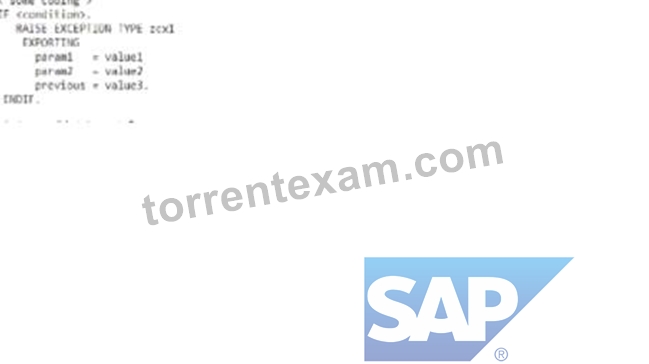
What are valid statements? Note: There are 2 correct answers to this question.
Answer: B,C
Explanation:
The code snippet in the image is an example of using the RAISE EXCEPTION statement to raise a class-based exception and create a corresponding exception object. The code snippet also uses the EXPORTING addition to pass parameters to the instance constructor of the exception class12. Some of the valid statements about the code snippet are:
* The code creates an exception object and raises an exception: This is true. The RAISE EXCEPTION statement raises the exception linked to the exception class zcxl and generates a corresponding exception object. The exception object contains the information about the exception, such as the message, the source position, and the previous exception12.
* "previous" expects the reference to a previous exception: This is true. The previous parameter is a predefined parameter of the instance constructor of the exception class cx_root, which is the root class of all class-based exceptions. The previous parameter expects the reference to a previous exception object that was caught during exception handling. The previous parameter can be used to chain multiple exceptions and preserve the original cause of the exception12.
You cannot do any of the following:
* "zcxl" is a dictionary structure, and "paraml" and "param2" are this structure: This is false. zcxl is not a dictionary structure, but a user-defined exception class that inherits from the predefined exception class cx_static_check. param1 and param2 are not components of this structure, but input parameters of the instance constructor of the exception class zcxl. The input parameters can be used to pass additional information to the exception object, such as the values that caused the exception12.
* "paraml" and "param2" are predefined names: This is false. param1 and param2 are not predefined names, but user-defined names that can be chosen arbitrarily. However, they must match the names of the input parameters of the instance constructor of the exception class zcxl. The names of the input parameters can be declared in the interface of the exception class using the RAISING addition12.
References: 1: RAISE EXCEPTION - ABAP Keyword Documentation - SAP Online Help 2: Class-Based Exceptions - ABAP Keyword Documentation - SAP Online Help
NEW QUESTION # 75
......
Did you have bad purchase experience that after your payment your emails get no reply, your contacts with the site become useless? Stop pursuing cheap and low-price C-ABAPD-2309 test simulations. You get what you pay for. You may think that these electronic files don't have much cost. In fact, If you want to release valid & latest SAP C-ABAPD-2309 test simulations, you need to get first-hand information, we spend a lot of money to maintain and development good relationship, we well-paid hire experienced education experts. We believe high quality of C-ABAPD-2309 test simulations is the basement of enterprise's survival.
C-ABAPD-2309 Reliable Exam Camp: https://www.torrentexam.com/C-ABAPD-2309-exam-latest-torrent.html
P.S. Free 2025 SAP C-ABAPD-2309 dumps are available on Google Drive shared by TorrentExam: https://drive.google.com/open?id=1f8xLSxcQvRIGD69uXQ_r6zr1Dreu2rwY